Updated: 2026-09-21 13:00
Greywater reuse, from monitoring to digital feedback
Project Eautonome is conducted at LEESU (Laboratoire Eau, Environnement et Systèmes Urbains), a joint research laboratory between École Nationale des Ponts et Chaussées (ENPC) and Université Paris-Est Créteil (UPEC).
Water is one of the most essential resources for human life. According to the World Health Organization, basic domestic needs require approximately 100 litres of water per person per day. In many urban areas, consumption exceeds this level. At the same time, projections indicate that more than half of the global population may face chronic water shortages by 2050. These conditions motivate approaches that extend beyond simple consumption reduction and include greywater reuse as well as improved understanding of domestic water use.
The Eautonome project focuses on domestic greywater reuse and water consumption monitoring in a residential house located in Noisiel, France. The system measures water use at different points in the domestic plumbing network using vortex flowmeters and a Bluetooth Low Energy showerhead.
The objective of this work is to develop a data processing framework for domestic water monitoring based on a Raspberry Pi gateway responsible for data routing, visualization, and storage. A second objective is to evaluate the accuracy of flow sensors under different pipe configurations and operating conditions. A further objective is to structure raw sensor data using W3C SOSA/SSN and ETSI SAREF4WATR ontologies.
The project contributes to Sustainable Development Goal 6 (Clean Water and Sanitation), Sustainable Development Goal 11 (Sustainable Cities and Communities), and Sustainable Development Goal 12 (Responsible Consumption and Production).



The sensing layer consists of vortex flowmeters and a Bluetooth Low Energy showerhead used to measure water consumption at different points of the domestic plumbing network. Sensor data is collected by a local Raspberry Pi gateway, processed, and made available for visualization and analysis.
The data model is based on the W3C SOSA/SSN and ETSI SAREF4WATR ontology to provide a consistent semantic representation of sensors and observations.
The dataset follows the FAIR principles to support structured and reusable data. The ontology developed in the project is publicly available at w3id.org/eautonome.
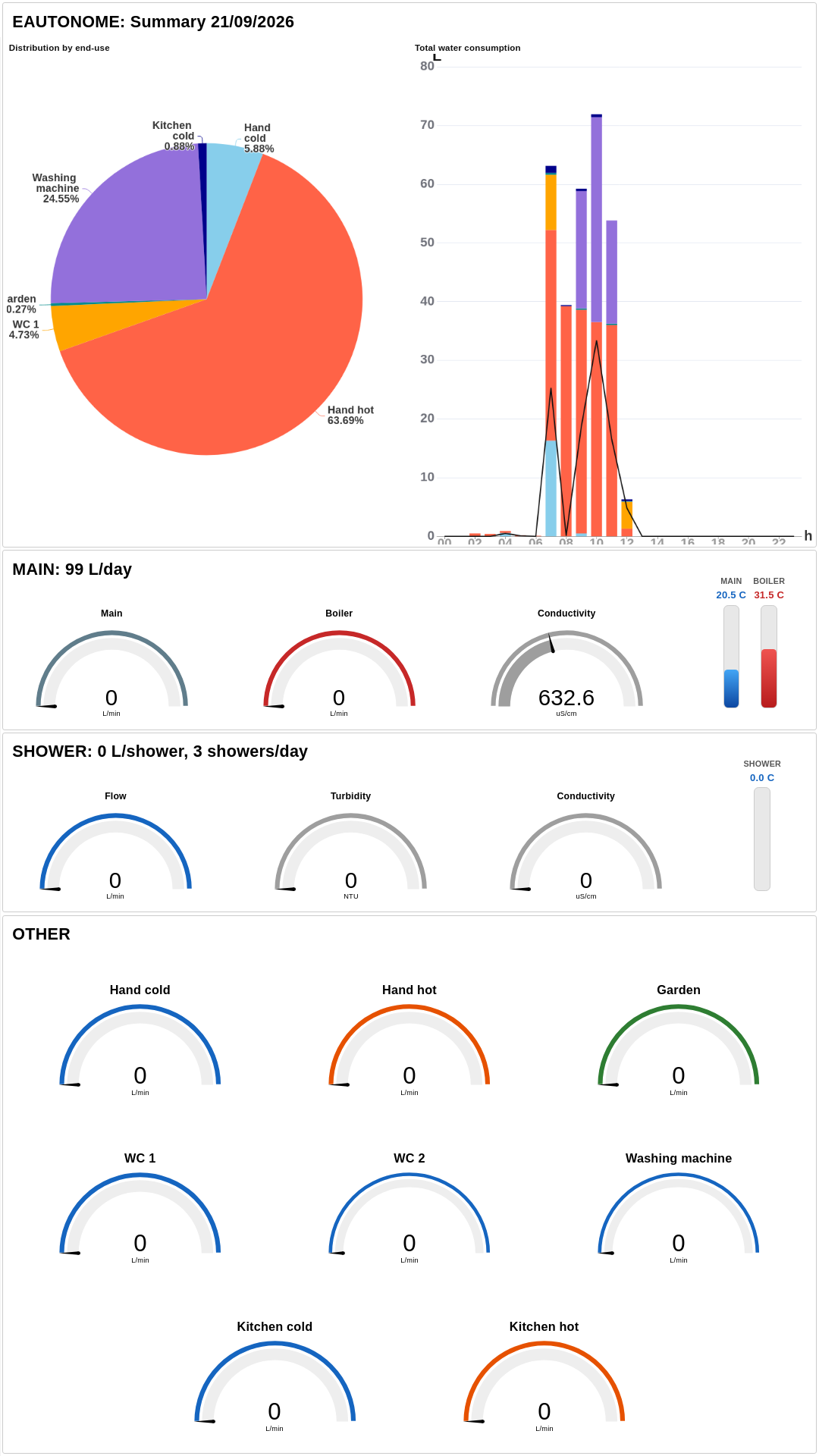
The system records water flow rate, conductivity, and temperature at multiple points in the house. This data provides users with feedback on their water consumption to support more informed water use. The dashboard below is updated automatically every hour.
Updated: 2026-09-21 13:00



Project Eautonome is a collaboration between LEESU, École Nationale des Ponts et Chaussées (ENPC), and Université Paris-Est Créteil (UPEC).
Martin Seidl
LEESU ENPC 2026

For information about the Eautonome project, contact LEESU:
Martin Seidl, martin dot seidl [at] enpc dot fr
LEESU, École Nationale des Ponts et Chaussées, Champs-sur-Marne